Supplement Pain and Low Energy Away: Naturopathic Protocol Part 3

1406058434805

Serrapeptase

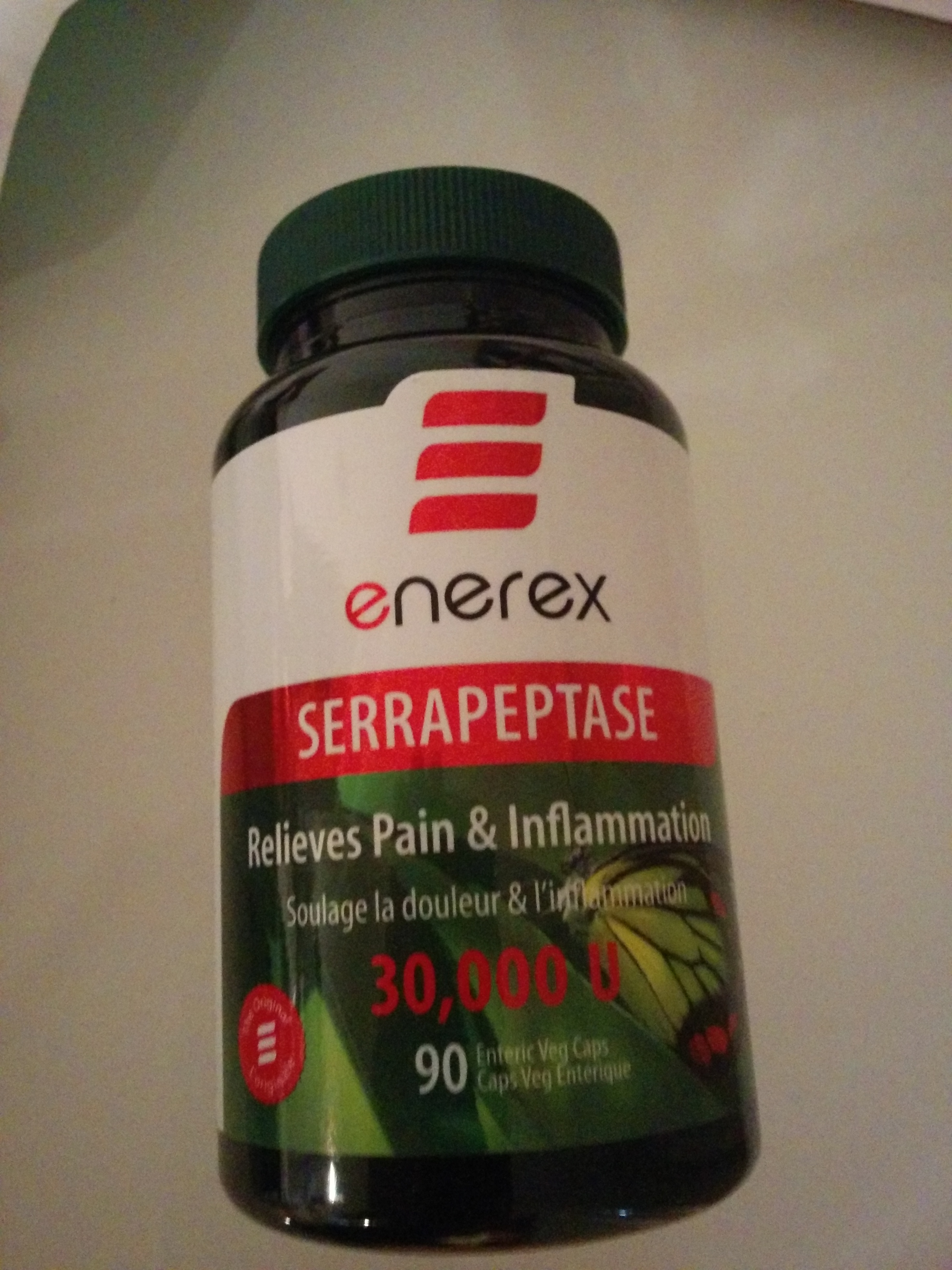
I had an appointment with my naturopath last week. She was happy with my progress so far. My stomach issues have been much better.  Last August, I did a food sensitivity test in combination with a food diary, and identified my trigger foods. After I eliminated these triggers, which included eggs, wheat/gluten, cruciferous veggies (broccoli, cauliflower, brussels sprouts) and beef, my gastrointestinal tract is been much happier. In addition, I also take a probiotic, an anti-yeast/anti-microbial supplement (Genestra Candicin) and intestinal support supplement (Metagenic Glutagenic with glutamine, aloe and licorice). This cocktail helps to keep things humming along nicely! If you’d like to know more, I wrote about it in a previous post: naturopathic protocol part 1. In the second phase of my protocol, my naturopathic prescribed D-ribose. I take 5 g daily, which is lower than the 10 to 15 g advised by some leading CFS/FMS researchers, but I found a higher doses gave me headaches. So far I have seen an increase in my energy levels – about 25%. At my most recent appointment, the naturopath wanted to address my pain issues more directly. She added a proteolytic enzyme called serrapeptase, which acts as an anti-inflammatory and pain killer. This enzyme, which was originally found in bacteria from the guts of silkworms, digests protein, and helps silkworms to break down their cocoons! In the human body, it reduces swelling by promoting drainage, inhibits pain-inducing amines called bradykinins, and breaks down dead tissue like plaques or adhesions.* It has been used in Asia and Europe for over 25 years and is backed by a significant body of research. Although it has not been studied specifically for use in treating fibromyalgia, it has been found to be effective for sprains and torn ligaments, carpal tunnel syndrome, post-op swelling, clots, arteriosclerosis and upper respiratory infections.* I think that this might be particularly effective for myofascial pain syndrome, which is characterized by trigger points in muscle groups, and frequently associated with fibromyalgia. Anti-inflammatories are more effective for myofascial pain syndrome than fibro, and I can imagine that in addition to its anti-inflammatory component, serrapeptase might help also help break down the adhesions and trigger points. My pain has been significantly reduced since I began taking it twice daily. The only tricky part is that you have to take it on an empty stomach so that the enzyme is absorbed into your bloodstream and not used up in the gut digesting protein in your food. My naturopath also prescribed an additional energy enhancing supplement which contains acetyl-L-carnitine and Coenzyme Q10. Both of these supplements have been found to improve fibromyalgia symptoms in recent studies. This past October, Spanish researchers published a study demonstrating clinical and molecular benefits from CoQ10 supplementation. This randomized, double-blind, placebo-controlled study included 20  participants diagnosed with fibromyalgia. Half of the subjects were given 300 mg of CoQ10 daily for 40 days. These subjects were found to have significantly reduced pain, fatigue and morning tiredness. Interestingly, these clinical results were corroborated by molecular findings. The researchers found recovery of inflammatory biomarkers, levels of antioxidant enzymes, mitochondrial function and expression of a gene called AMPK. This gene codes for an enzyme that plays an important role in cellular energy metabolism. The study concluded that CoQ10 may be beneficial for fibromyalgia sufferers. In 2007, researchers published a study that looked at the effects of acetyl l-carnitine supplementation in patients with fibromyalgia. Over 100 patients were enrolled in the study. The active group were given over 1000 mg of acetyl l-carnitine daily plus 1 intramuscular injection of 500 mg weekly for 10 weeks, and the control group was given a placebo. Researchers found significant benefits in the active group from supplementation, specifically in reduced tender point pain, overall musculoskeletal pain and depressive symptoms. They concluded that acetyl l-carnitine is a helpful supplement for pain and mental health in fibromyalgia patients. I am taking different amounts of these two supplements than were studied. My formula includes 80 mg of CoQ10 and 100 mg of acetyl l-carnitine daily. I have only been taking this supplement for a few days, so I will have to report back later on any effects I feel. If I don’t see any effects, then maybe I will have to consider taking a higher dose! Both of these supplements are involved in cellular energy metabolism, which is interesting because the primary theory at the moment is central sensitization of pain processing. Fibromyalgia must be some kind of crazy jigsaw puzzle – but obviously it has far-reaching effects in our bodies. Anyway, that’s enough research nerding for one day! Have a happy day! Rossini M, Di Munno O, Valentini G, Bianchi G, Biasi G, Cacace E, Malesci D, La Montagna G, Viapiana O, Adami S. ‘Double-blind, multicenter trial comparing acetyl l-carnitine with placebo in the treatment of fibromyalgia patients’. Clin Exp Rheumatol. 2007 Mar-Apr;25(2):182-8. . **Mario D. Cordero, Elísabet Alcocer-Gómez, Manuel de Miguel, Ognjen Culic, Angel M. Carrión, José Miguel Alvarez-Suarez, Pedro Bullón, Maurizio Battino, Ana Fernández-Rodríguez, and José Antonio Sánchez-Alcazar. Antioxidants & Redox Signaling. October 20, 2013, 19(12): 1356-1361. doi:10.1089/ars.2013.5260. *’All about supplements: Serrapeptase – the natural anti-inflammatory’. Life Extension Magazine, September 2003. Accessed November 14, 2013. http://www.lef.org/magazine/mag2003/sep2003_report_aas_01.htm ‘Studies show benefit of CoQ10 in fibromyalgia’. Natural news, April 26, 2013. Accessed November 18, 2013. http://www.nyrnaturalnews.com/pain-2/2013/04/studies-show-benefit-of-coq10-in-fibromyalgia/

Nondrug, Trigger Point and Alternative Fibromyalgia Treatment

“The good news is that many therapies can ease this type of muscle pain, and for the most part, their side effects are minimal. Various movement therapies and nourishing supplements may reduce chances that trigger points will develop in the first place. Consider trying out a variety of the alternative treatment options described below, based on your needs.” Fabulous reference for non-drug options!

Nondrug, Trigger Point and Alternative Fibromyalgia Treatment.

Volunteering

I’ve dropped of the face of the earth during the last week, because all of my energy has been taken up with a new project – volunteering at a local hospital. It’s the same hospital where my pain clinic is located, so it made sense to volunteer there. I have been thinking of volunteering for a long time, but felt very intimidated by the whole idea.

Fibromyalgia dropped in on my life like a tonne of bricks during graduate school and forced me to stop everything. My symptoms developed over a 6 month period and took away my abilities piece by piece. The process left me feeling incompetent and unsure of being able to do anything. It doesn’t make sense; I know theoretically that it was pain not ineptitude that forced me to stop. Yet, it was a damaging experience  –  trying to get  the right combination of extensions, sick leaves and accommodations to successfully finish my workload, only to find that nothing was enough except stopping altogether . I stayed in a bubble for over a year after I withdrew from my program because of it.

I have been slowly going crazy in my bubble and knew I needed to do something about it. I have had some success doing online (free!) university courses with Coursera (and recently discovered that my local library has some courses on DVD about art and literature). I have been looking for an exercise class to join. There is a tai chi organization that offers gentle health promotion classes near me. Also, my local YMCA apparently has gentle aqua fit classes in a warm pool. The problem with these ideas is that they cost money and I am always worried about if I can really do it or not. Volunteering is perfect because it is free and also, because you are giving your time, it can theoretically be on your terms. Also, as a person living with a chronic illness, I think it is beneficial to find a way to feel helpful or useful. In line with cognitive behavioral therapy, it is good to focus on the positive aspects of your circumstances (if I compare living with fibromyalgia to my old life I feel down but if I can compare it to having cancer or other terminal illness I feel grateful).
I chose the hospital after looking at a number of positions because they wanted a 4 hour commitment, once a week, during day time hours. A lot of positions wanted more hours, on evenings and weekends, or involved computer work. (I have some severe trigger points around my shoulder blades which prevent me from typing. I use voice to text software for blogging and e-mails. This means I have to do it at home where talking to myself doesn’t look quite as crazy! The software is also a bit clunky which is why I can’t blog more). I will be at an information desk on one of the hospital floors. This seems to suit my body fairly well because I can either sit or stand and talk with patients. I can also put my backrest and seat cushion on the chair to help me get through the full shift. I also feel like it is a good position to start with. I was nervous about beginning with patient visiting or something because of needing to appear cheerful and ‘on’. Dealing with pain and mood swings makes me question whether I can appear chatty and upbeat on demand.

I originally applied to another hospital network, but their bureaucratic approach was really getting me down. I already deal with enough of the medical system bureaucracy as the patient without having to deal with it in my free time as a volunteer! When I went to make an appointment with occupational health to show them my vaccines were up to date and they told me I had to wait five weeks for the next available appointment I almost gave up. Finally, I wrote the hospital I finally did get a position with, and they had me come in for an orientation just a few days later. I was so nervous before my orientation and my first training shift. That made me feel doubly crazy because why was I so nervous over a little volunteering commitment? It seems like since my fibromyalgia diagnosis I have generally been more anxious about things that I used to be. I also relate it back to when I was first diagnosed. I think going through that process where the abilities you took for granted get taken away makes you feel like you can’t take it for granted that you have any ability. There are also many more things to be anxious about – will I be able to make it every week? What if the chair hurts my back? What if someone asks me to help lift or carry something heavy? Will I  look weird with my backrest and cushion?

This story has a happy ending. I did my first shift on my own this past Monday. I was able to help a few very lost and confused patients find their appointment locations (why do they always design hospitals to be like mazes?). It felt good to be helpful and I could feel my inner extrovert perking up a little bit. Next time I need to bring a magazine or two for those dead in between times. I also need to buy a pair of black pants because skirts are definitely not cutting it in this frosty fall weather (sadly, no blue jeans are allowed). I think that this will end up being a very positive baby step in the right direction for me and I encourage everyone else who can to give volunteering a try.

I think volunteering with organizations that focus on health issues is less daunting. Hospitals, seniors centers, the arthritis society, etc. are more likely to be accommodating. For example, my fiancée works with a health nonprofit and he has noticed that at health fairs the arthritis society volunteers have had their materials couriered for them. Nowadays, there are also online volunteering opportunities, which might be more appropriate for some people. I did a quick Google search and found a good article here which mentions opportunities like United Nations Volunteers. There is definitely a lot more out there than your local food bank and I think volunteers often feel like they end up taking more away from the experience than they contribute because it is usually very rewarding.

Liebster Award

http://trynabpainfreemomma.files.wordpress.com/2013/10/liebster-award.jpg

Wow! Thank you so much to Michelle over at trynabpainfreemomma.wordpress.com for nominating my blog for the Liebster award! I really enjoy reading her posts – I always find things I can relate to and so much interesting information on fibromyalgia. That’s what I’ve really come to like about blogging; it’s not so much about putting your own experiences out there but finding other bloggers to learn from. Some posts give you a helpful way to see things in a positive light, others express the same frustrations that you feel as a person living with chronic pain. There’s something very reassuring about realizing you’re not the only person going through the crazy fibromyalgia roller coaster! Of course there’s also all that great information about recent research, things to try, and strategies to cope, too. I’m honored to think that other bloggers might be getting some of the same things out of reading my blog!

What is the Liebster award? It is an Internet award given by bloggers to other bloggers. It follows similar rules to chain letters, in that you pay it forward to other bloggers after you receive it. ‘Liebster’ is German for ‘dearest’, ‘sweetest’, ‘kindest’. The name relates to the purpose of the award which is to give recognition to new bloggers – which is a nice thing to do! (You can find more information here at http://trynabpainfreemomma.wordpress.com/2013/10/12/id-like-to-thank-the-academy/ ).

The rules:

1. Link back and recognize the blogger who nominated you.

 2. Answer ten questions given to you, by the person who nominated you.

 3. Nominate ten other bloggers for the award.

 4. Create ten questions for your nominees to answer.

 5. Notify your nominees.

 6. And lastly, you may copy and paste the award on your blog!

So, on to answering the questions created by my nominee:

1. What inspires you to blog?

I started blogging because I wanted to share all of the things that I’ve tried and done to manage my fibromyalgia. I thought it would be helpful for me to have a place where I compiled all of the research, complementary and alternative treatments, meditation experiences, tips and tricks, and other things that I’ve learned help me. I also hope that it gives other readers something to add to their fibro toolbox. In the process, I have learned that the community of other bloggers makes blogging rewarding.

2. What are your other hobbies?

I am a hopeless nerd who always needs to be learning something. If I don’t get that kind of mental input I start to go crazy. At the moment I am taking free online courses at Coursera in everything from ancient Greece to psychology. I also enjoy reading, although it has to be an audio book, because my shoulders get too sore from holding an actual book. I like mystery novels (nothing too gruesome though) and fiction (with a happy ending). I like cooking, watching movies, taking walks outside, and spending time with friends.

3. Do you hope to make money blogging?

That’s not a goal I have at the moment. I don’t really like the idea of making money off of sharing my personal experiences, but on the other hand I can understand that if you had a very successful blog it would be tempting, especially for people like me who can’t work because of their chronic pain.

4. Do you hokey pokey?

Only at three in the morning!

5. What is the most inspiring place you’ve traveled to?

Traveling! I didn’t add that to my list of hobbies because it’s not something I can do at the moment, but I have spent a number of years studying and working abroad. Without a doubt the most inspiring place I have visited is East Africa (Kenya, Uganda, Tanzania). I was with a student group and we visited a remarkable nonprofit who ran youth programs in a slum in Nairobi (soccer teams, homework clubs, a safe hangout area, and primary health care lessons). When I imagined slums, I definitely didn’t think it would look like what I found – music everywhere, hair salons, restaurants, people laughing, people inviting you in for dinner. Yes, all of this took place in the characteristic tiny aluminum shacks crammed together along garbage and waste strewn pathways. But it was Life in the face of crushing poverty. Incredibly inspiring.

6. What quote, and by whom, inspires you?

“God, grant me the serenity to accept the things I cannot change,

The courage to change the things I can,

And wisdom to know the difference.” – Serenity Prayer

7. If you thought the government powers that be would actually listen to you what would you say?

Inequality is unacceptable. Equality includes not just political and civil rights, but social and economic rights too. Everyone should have access to education, healthcare and meaningful opportunities. There is really no reason for developed countries to have increasing income disparity and other inequalities. We should also do more to ensure that developing countries have access to funds, technologies, and medications that they need, supported by fair political and economic policies.

8. What is your favorite movie genre? why?

This is a tricky one. I definitely like action movies, especially heist films. I also like dramas. But just like with fiction, I don’t really want to spend my time on stories that make you feel like life isn’t worth living, no matter how ‘compelling’ or ‘critically acclaimed’. Recent movies that I’ve enjoyed are ‘The Quartet ‘, ‘Mud’, ‘2 Guns’ and ‘Red’.

9. Whom do you hope to be an inspiration to?

My little brothers. Well, they’re great big hulking teenage boys now, but still much younger than me!

10. My life is _____the only one I’ve got, so I have to do my best with what I have!

My 10 Liebster Award Nominees …

http://myjourneythrume.wordpress.com/about/

http://seekingthegiftsoffibromyalgia.blogspot.com.au/

http://chronicchic.com/

http://discoveriesofgrace.wordpress.com/

http://fibro2010.com/

http://findmyhealth.blogspot.ca

http://glutenfreeandtheaustralianteenager.wordpress.com/

http://chronic-invisibility.blogspot.ca/

http://bignoises.wordpress.com/

http://www.livinglifewithfms.com/

Okay, so now 10 questions for my nominees:

1. What do you like most about blogging?

2. What is your guilty pleasure?

3. What to like to do on a Sunday?

4. What quality do you like most about yourself?

5. Who is one of your role models and why?

6. Who is your favorite author and why?

7. If you had to move to another country, what would it be?

8. Favorite TV show? Do you like to watch week to week or binge watch all at once?

9. If you had to make one wish, what would it be?

10. Cats or dogs? Pirates or ninjas?


Creating Chronic Pain Awareness (You can help!)

As part of Chronic Pain Awareness month (September) this is an awareness-raising activity from a great blog, Oh What a Pain in the… There are questions about the experience of living with chronic pain which readers have filled out in the comments section – read to learn more or add your own ideas at Oh what a pain in the … and pass it on.

Natural Treatments for Fibromyalgia: Why you should Try D-Ribose

Natural Treatments for Fibromyalgia: Why you should Try D-RiboseThe first part of my natural treatment protocol for FM was focused on healing my digestive tract (which I described in a previous post). The second phase is to begin incorporating d-ribose.

D-ribose is a sugar produced in the body and taken to alleviate fatigue and pain in fibromyalgia and chronic fatigue syndrome. Here’s what the research says about this supplement.

The biggest advocate for d-ribose is Dr. Teitelbaum, a prominent doctor in the field of chronic fatigue and fibromyalgia medicine. He has developed a program for treating both conditions which includes d-ribose as a core component. Dr. Teitelbaum contends that CFS/FMS is caused by an “energy crisis” in the body, leading to a cascade of different symptoms like fatigue, pain, sleep disturbance, among others. One root cause of the energy problem, he argues, is that the ability of the mitochondria in your cells to generate energy is suppressed. Mitochondria produce the energy, called ATP, used by your cells to carry out all their functions. D-ribose is essential to the production of ATP. Therefore, taking additional D-ribose should help to support mitochondrial function and improve energy output in fatigued patients. (If you are interested in learning more, check out a much longer discussion found on Dr. Teitelbaum’s website here).

The evidence? Dr. Teitelbaum has authored a few pilot studies that have demonstrated some promising results. The most recent study was an open-label study published in 2012. In this multicenter study, 257 patients diagnosed with CFS/FMS were given d-ribose (5 g three times daily for three weeks). Patient symptoms were assessed in terms of subjective change in energy, sleep quality, mental clarity, pain level, and global sense of well-being, and compared to their pre-study baseline. Significant improvements were found; specifically a 61.3% increase in energy, 37% increase in general well-being, 29% improvement in sleep, 30% improvement in mental clarity, 15.6% decrease in pain.

Sounds great, right? There are some limitations to the study. First of all, there was no placebo group so we don’t have a sense of how much a placebo effect might have impacted the results. Secondly, it was quite a short study so long term effects were not captured in the results. Third, I always feel a bit suspicious of studies that lump chronic fatigue and fibromyalgia together because a lot of recent research has demonstrated different causes for the two conditions and mixing them together might conflate the results.

Personally, I have found D-ribose a helpful aid to improving my energy. I would say that it improves my energy by 15-20%. I take 5mg in the morning, and sometimes an additional 5mg in the afternoon. When I stopped taking it, I noticed a worsening of my afternoon brain fog and fatigue. I didn’t notice a worsening of pain or sleep however. I also appreciate that it is easy to take –  just mix a spoonful with a glass of swater- instead of yet another pill. It is also relatively inexpensive.

As with everything fibromyalgia or chronic fatigue related, it is an individual experience, so you have to try it for yourself. In the case of d-ribose, I think it is definitely worth a try!

Check out other great posts on the Fibro Friday Linkup!

References

Teitelbaum JE, et al. “Treatment of chronic fatigue syndrome and fibromyalgia with D-ribose – An open-label, multicenter study.” The Open Pain Journal. 2012, 5,32-37

Natural Treatments for Fibromyalgia: Healing Your Digestive Tract

natural-treatment-for-fibromyalgia-healing-the-digestive-tract

I’ve just started a new naturopathic protocol, focusing on healing my digestive tract.My naturopath wants to start with the digestive tract for a couple of reasons. First of all, my IBS and pelvic pain symptoms suggest that my G.I. tract is inflamed. One cause of digestive problems is “leaky gut syndrome” – a colourful name for a condition in which the the digestive lining becomes too permeable, or “leaky”, allowing partially digested proteins and harmful substances/microbes into the bloodstream. These foreign particles are attacked by white blood cells, causing inflammation and overtaxing the immune system. Inflammation like this can prevent absorption of necessary nutrients and energy, which can in turn aggravate chronic illness symptoms. This might also affect my ability to absorb other supplements that I need, so it seems like a good place to start.

Secondly, the digestive tract is a critical part of the immune system. Inflammation, microflora (bacteria and other microbes) imbalance, and yeast overgrowth are probably all issues that I need to address. Having my immune system all tied up addressing these problems could be significantly impairing my body’s ability to function in other ways. Fatigue, pain, poor tissue repair, susceptibility to infection and other fibromyalgia and chronic fatigue symptoms can be aggravated by immune dysfunction. Freeing up my immune system from dealing with digestive inflammation and microbe imbalance could enable healing and re-energizing down the line. Here I want to share research on supplements that can help heal the digestive tract lining – an important step to help manage fibromyalgia symptoms. If you are interested in additional steps, I’ve written about the benefits of Probiotics and Fibro in a separate post and avoiding  foods that you are sensitive to, based on food sensitivity testing and/or an elimination diet.

  • L – glutamine is an amino acid (protein building block) produced in the body, stored in muscles and the lungs.* It has a number of functions in the body, including eliminating excessive ammonia waste, helping to provide nitrogen and carbon ‘fuel’ to cells, and helping in the synthesis of other amino acids and glucose, among others. Although the body usually produces adequate amounts of glutamine, in times of stress or illness the body’s production may be insufficient. Glutamine is included in this supplement in order to supply a source of fuel and precursors for growth to the rapidly dividing cells of the intestinal lining”.
  • deglycyrrhizinized licorice (DGL) licorice has been traditionally used in many cultures to promote health. This form removes an element in licorice called glycyrrhizin which can cause water retention, edema and hypertension issues. DGL is effective for treating gastric irritation, ulcers (one study found it to be as effective as a common over-the-counter medicine), heartburn, and other digestive problems. It also may be helpful for treating adrenal gland problems and reducing fatigue.**
  • aloe helps to heal inflamed intestines and can promote the integrity of the digestive lining. Aloe has a few properties which ease this process, which include balancing the pH of the G.I. tract, and antimicrobial properties which aid in healing.*** This may counteract leaky gut symptoms.


These ingredients are all included in a supplement called Metagenics Glutagenics. My dose is 1/4 teaspoon two times daily (of powder mixed into water).

*http://umm.edu/health/medical/altmed/supplement/glutamine

**http://www.huffingtonpost.com/julie-chen-md/dgl-supplements_b_2976260.html

***http://www.crohns.net/Miva/education/aboutaloe.shtml

http://www.webmd.com/digestive-disorders/features/leaky-gut-syndrome

Mentally Mindful

Image

In the past two weeks I finally moved into my new apartment and it is starting to feel like home. The silence and the space are so much more conducive to learning mindful living then the construction zone I lived in before. I did not feel very Zen during the move or unpacking, but that’s what I’m working on now. No time like the present!

The second part of chapter 2 in The Mindfulness Solution To Pain by Dr. Jackie Gardner – Nix talks about mental attitudes related to mindfulness. (I’m going to keep summarizing the key points that jumped out at me, and connections I made to my own life; I don”t want to put citations everywhere). Attitudes can be enabling or harmful to our well-being, and awareness about these attitudes can help us to strengthen positive ones and change negative ones.

The first attitude associated with mindfulness is being nonjudgmental. This is something that I have a long way to go to achieve! On Monday I was listening to Dr. Jackie Gardner – Nix’ guided meditation (more on this in a moment) and my practice was not going as well as last week. Every other breath I caught myself thinking things like “my breathing is too fast and shallow”, “why can’t I stay focused today?”, “I don’t think I’m ever going to get this right”. In the book, the authors point out that judgments about whether something is positive or negative are very black and white, and often miss the ‘gray’ nuanced part of experiences. Bad experiences can have silver linings, and good things aren’t always what they seem. Negative judgments can begin a domino effect of reactive emotions, tension and increased pain. Given the changeability and impermanence of things, judgments can really be a waste of time. I’m going to have to work on this in meditation practice and in the rest of my life too! Being off work on disability leave, as I’ve mentioned before, definitely leads me to be very judgmental about the lack of accomplishment, purpose, etc. I think they called this the inserting “superwoman overachiever cycle” in the last chapter!I really liked the observation made in the book that it can be freeing to experience situations or encounters with people and not judge them.

The second attitude associated with mindfulness is the beginner’s mind. To achieve this mental stance, you have to try to overcome your own biases, prejudices and preconceived notions, and not bring them to present situations or encounters. This reminds me of what my anthropology professors called ‘reflexive thinking’. Anthropologists believe that it’s impossible to cultivate a purely objective stand point, but by being aware of your own subjective point of view, you can still produce valuable insights and new knowledge about the culture you are studying. So this mindful attitude sounds to me like being an anthropologist studying yourself!

The third and fourth attitudes to cultivate are trust and patience. Trust that developing awareness will lead to change over time, and patience regarding how long that will take.

The next chapter (chapter 3) is about beginning a formal meditation practice. The authors define this as “intentionally setting aside a specific period of time… In your day to systematically cultivate mindfulness by focusing your attention moment by moment on some particular aspect of your experience, and actively noting when your mind wanders – as it always will – and then bringing it back to the focus” (Gardner-Nix and Costin-Hall, 2009). Usually breathing is the focus of mindfulness practice. I decided to buy Dr. Gardner-Nix’ CD of guided meditations, called ‘meditations for the mindfulness solution to pain’, which is available on iTunes. I thought it would be best to go with this one because it is designed to specifically accompany the book. The authors also recommend Andrew Weil’s “meditation for optimum health”, available from Sounds True (Google for website).  I also really like John Kabat-Zinn’s disc of guided meditations called “mindfulness meditation for pain relief”.  I’m not going to give a detailed summary of how to meditate because I think these resources to a much better job than I ever could. I did just want to mention the advice given at the end of this chapter to pace yourself while incorporating meditation into your daily routine – start with 5 min., slowly work up to 10, then 20, and so on. I’m at 10 minutes right now. I’d like to work up to 20, eventually without the guide, but for now I like listening 😉 p.s. I don’t sit cross-legged in serene white while meditating. I have to lie down with pillows under my legs on the couch or on the floor – fibrostyle. My body wouldn’t put up with that kind of sitting!

image courtesy of photostock at FreeDigitalPhotos.net