This meditative movement practice has been shown to help relieve pain and other symptoms of fibromyalgia. My physical therapist (physiotherapist) says that it is an effective way to treat central nervous system sensitization – the favored explanation of the mechanism underlying fibromyalgia. On a handout she gave me it says that qi gong practice “increases the awareness of the body and helps with mapping movement and sensation in the sensor-motor cortex (the region of the brain that is responsible for sensations from the body and movement) . It also helps to facilitate deep abdominal breathing in an active, yet calm way. It loosens up the spine to decrease sympathetic nervous system up-regulation. It teaches you to move without tension, and helps to decrease stress. It is an active way to improve the mind-body connection.”
http://www.medpagetoday.com/clinical-context/Fibromyalgia/34120
I’d like to include some resources to consider. I started with a very gentle 12-15 minute program (warm-up, qi gong, cool down). I used a DVD by Dr. Paul Lam called Qi Gong for Health. It’s a little outdated but very gentle and accessible. It can be ordered online.
I looked up some other resources. ‘Heal Yourself with Qigong’ by Suzanne Friedman looks like an excellent book. There are also lots of classes in communities everywhere – but I would sit and watch to see if it’s the right level first.
Category: Research

Fight Fibromyalgia With Shiatsu – Prevention.com


Supplement Pain and Low Energy Away: Naturopathic Protocol Part 3
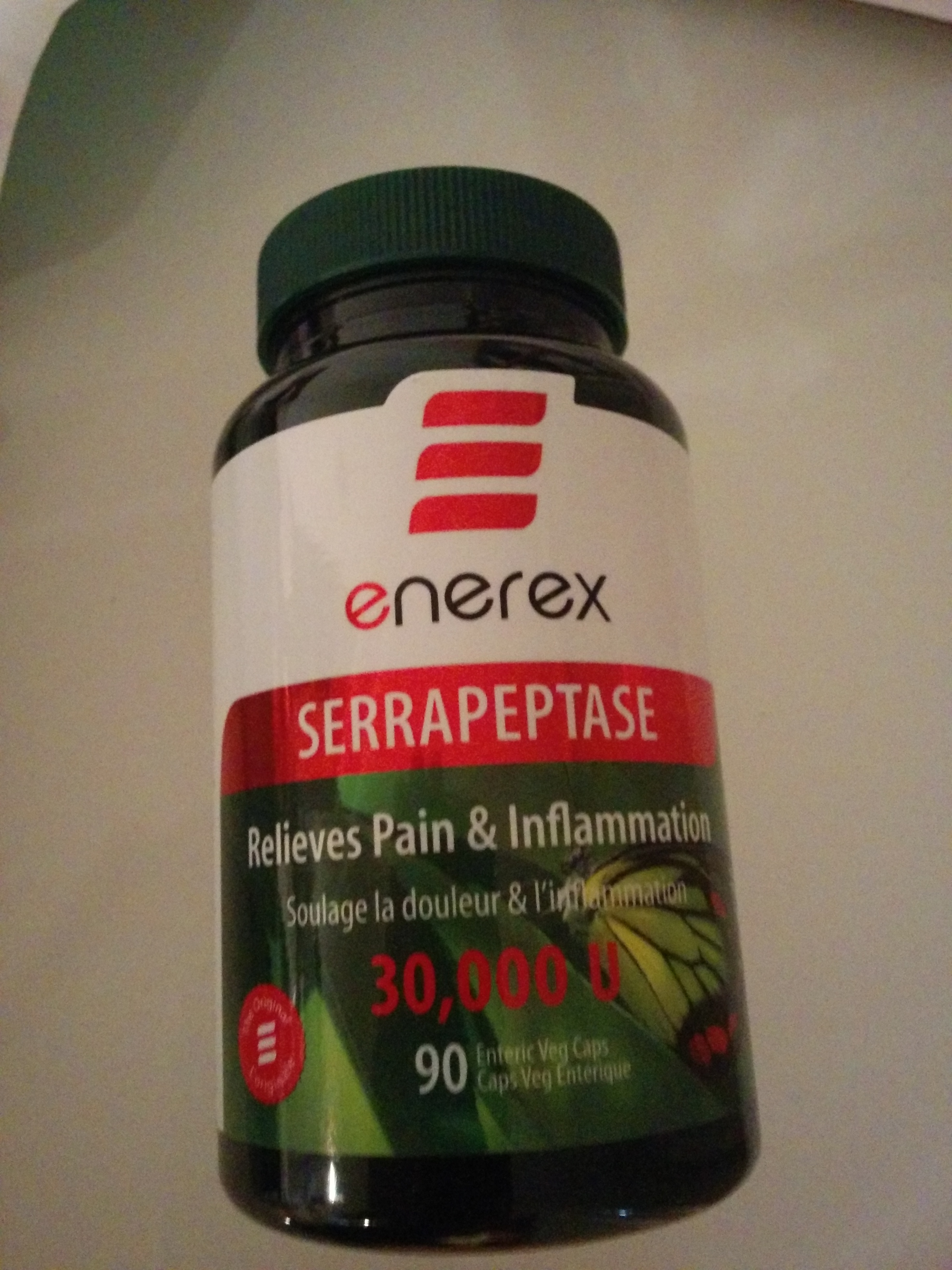
Serrapeptase
I had an appointment with my naturopath last week. She was happy with my progress so far. My stomach issues have been much better. Last August, I did a food sensitivity test in combination with a food diary, and identified my trigger foods. After I eliminated these triggers, which included eggs, wheat/gluten, cruciferous veggies (broccoli, cauliflower, brussels sprouts) and beef, my gastrointestinal tract is been much happier. In addition, I also take a probiotic, an anti-yeast/anti-microbial supplement (Genestra Candicin) and intestinal support supplement (Metagenic Glutagenic with glutamine, aloe and licorice). This cocktail helps to keep things humming along nicely! If you’d like to know more, I wrote about it in a previous post: naturopathic protocol part 1. In the second phase of my protocol, my naturopathic prescribed D-ribose. I take 5 g daily, which is lower than the 10 to 15 g advised by some leading CFS/FMS researchers, but I found a higher doses gave me headaches. So far I have seen an increase in my energy levels – about 25%. At my most recent appointment, the naturopath wanted to address my pain issues more directly. She added a proteolytic enzyme called serrapeptase, which acts as an anti-inflammatory and pain killer. This enzyme, which was originally found in bacteria from the guts of silkworms, digests protein, and helps silkworms to break down their cocoons! In the human body, it reduces swelling by promoting drainage, inhibits pain-inducing amines called bradykinins, and breaks down dead tissue like plaques or adhesions.* It has been used in Asia and Europe for over 25 years and is backed by a significant body of research. Although it has not been studied specifically for use in treating fibromyalgia, it has been found to be effective for sprains and torn ligaments, carpal tunnel syndrome, post-op swelling, clots, arteriosclerosis and upper respiratory infections.* I think that this might be particularly effective for myofascial pain syndrome, which is characterized by trigger points in muscle groups, and frequently associated with fibromyalgia. Anti-inflammatories are more effective for myofascial pain syndrome than fibro, and I can imagine that in addition to its anti-inflammatory component, serrapeptase might help also help break down the adhesions and trigger points. My pain has been significantly reduced since I began taking it twice daily. The only tricky part is that you have to take it on an empty stomach so that the enzyme is absorbed into your bloodstream and not used up in the gut digesting protein in your food. My naturopath also prescribed an additional energy enhancing supplement which contains acetyl-L-carnitine and Coenzyme Q10. Both of these supplements have been found to improve fibromyalgia symptoms in recent studies. This past October, Spanish researchers published a study demonstrating clinical and molecular benefits from CoQ10 supplementation. This randomized, double-blind, placebo-controlled study included 20 participants diagnosed with fibromyalgia. Half of the subjects were given 300 mg of CoQ10 daily for 40 days. These subjects were found to have significantly reduced pain, fatigue and morning tiredness. Interestingly, these clinical results were corroborated by molecular findings. The researchers found recovery of inflammatory biomarkers, levels of antioxidant enzymes, mitochondrial function and expression of a gene called AMPK. This gene codes for an enzyme that plays an important role in cellular energy metabolism. The study concluded that CoQ10 may be beneficial for fibromyalgia sufferers. In 2007, researchers published a study that looked at the effects of acetyl l-carnitine supplementation in patients with fibromyalgia. Over 100 patients were enrolled in the study. The active group were given over 1000 mg of acetyl l-carnitine daily plus 1 intramuscular injection of 500 mg weekly for 10 weeks, and the control group was given a placebo. Researchers found significant benefits in the active group from supplementation, specifically in reduced tender point pain, overall musculoskeletal pain and depressive symptoms. They concluded that acetyl l-carnitine is a helpful supplement for pain and mental health in fibromyalgia patients. I am taking different amounts of these two supplements than were studied. My formula includes 80 mg of CoQ10 and 100 mg of acetyl l-carnitine daily. I have only been taking this supplement for a few days, so I will have to report back later on any effects I feel. If I don’t see any effects, then maybe I will have to consider taking a higher dose! Both of these supplements are involved in cellular energy metabolism, which is interesting because the primary theory at the moment is central sensitization of pain processing. Fibromyalgia must be some kind of crazy jigsaw puzzle – but obviously it has far-reaching effects in our bodies. Anyway, that’s enough research nerding for one day! Have a happy day! Rossini M, Di Munno O, Valentini G, Bianchi G, Biasi G, Cacace E, Malesci D, La Montagna G, Viapiana O, Adami S. ‘Double-blind, multicenter trial comparing acetyl l-carnitine with placebo in the treatment of fibromyalgia patients’. Clin Exp Rheumatol. 2007 Mar-Apr;25(2):182-8. . **Mario D. Cordero, Elísabet Alcocer-Gómez, Manuel de Miguel, Ognjen Culic, Angel M. Carrión, José Miguel Alvarez-Suarez, Pedro Bullón, Maurizio Battino, Ana Fernández-Rodríguez, and José Antonio Sánchez-Alcazar. Antioxidants & Redox Signaling. October 20, 2013, 19(12): 1356-1361. doi:10.1089/ars.2013.5260. *’All about supplements: Serrapeptase – the natural anti-inflammatory’. Life Extension Magazine, September 2003. Accessed November 14, 2013. http://www.lef.org/magazine/mag2003/sep2003_report_aas_01.htm ‘Studies show benefit of CoQ10 in fibromyalgia’. Natural news, April 26, 2013. Accessed November 18, 2013. http://www.nyrnaturalnews.com/pain-2/2013/04/studies-show-benefit-of-coq10-in-fibromyalgia/
Related articles
- Did You Know? It’s Naturopathic Medicine Week (healthbistro.lifescript.com)
Share this:

Nondrug, Trigger Point and Alternative Fibromyalgia Treatment
“The good news is that many therapies can ease this type of muscle pain, and for the most part, their side effects are minimal. Various movement therapies and nourishing supplements may reduce chances that trigger points will develop in the first place. Consider trying out a variety of the alternative treatment options described below, based on your needs.” Fabulous reference for non-drug options!
Nondrug, Trigger Point and Alternative Fibromyalgia Treatment.
Share this:

Pleasure and pain brain signals disrupted in fibromyalgia patients – Medical News Today
Pleasure and pain brain signals disrupted in fibromyalgia patients – Medical News Today.
… Dr. Loggia concludes, “Our findings suggest that fibromyalgia patients exhibit altered brain responses to punishing and rewarding events, such as expectancy of pain and relief of pain. These observations may contribute to explain the heightened sensitivity to pain, as well as the lack of effectiveness of pain medications such as opioids, observed in these patients. Future studies should further investigate the neurochemical basis underlying these dysfunctions.”
Share this:

Young people report worse fibromyalgia than older patients
Oct. 27, 2013 — It may seem counterintuitive, but young and middle-aged fibromyalgia patients report worse symptoms and poorer quality of life than older patients, a Mayo Clinic study shows…
Young people report worse fibromyalgia than older patients.
Share this:

Brain abnormality ‘predictor of chronic pain’
Brain abnormality ‘predictor of chronic pain’.
This article is about a fascinating study which demonstrates how a brain abnormality increases the likelihood that an acute back injury will become chronically painful. The abnormality has to do with parts of the brain that process emotional reactions to pain. This makes people who have it vulnerable to “enhanced emotional learning” which magnifies the pain and its significance… leading to chronic pain.
Share this:

Natural Treatments for Fibromyalgia: Why you should Try D-Ribose
 The first part of my natural treatment protocol for FM was focused on healing my digestive tract (which I described in a previous post). The second phase is to begin incorporating d-ribose.
D-ribose is a sugar produced in the body and taken to alleviate fatigue and pain in fibromyalgia and chronic fatigue syndrome. Here’s what the research says about this supplement.
The biggest advocate for d-ribose is Dr. Teitelbaum, a prominent doctor in the field of chronic fatigue and fibromyalgia medicine. He has developed a program for treating both conditions which includes d-ribose as a core component. Dr. Teitelbaum contends that CFS/FMS is caused by an “energy crisis” in the body, leading to a cascade of different symptoms like fatigue, pain, sleep disturbance, among others. One root cause of the energy problem, he argues, is that the ability of the mitochondria in your cells to generate energy is suppressed. Mitochondria produce the energy, called ATP, used by your cells to carry out all their functions. D-ribose is essential to the production of ATP. Therefore, taking additional D-ribose should help to support mitochondrial function and improve energy output in fatigued patients. (If you are interested in learning more, check out a much longer discussion found on Dr. Teitelbaum’s website here).
The evidence? Dr. Teitelbaum has authored a few pilot studies that have demonstrated some promising results. The most recent study was an open-label study published in 2012. In this multicenter study, 257 patients diagnosed with CFS/FMS were given d-ribose (5 g three times daily for three weeks). Patient symptoms were assessed in terms of subjective change in energy, sleep quality, mental clarity, pain level, and global sense of well-being, and compared to their pre-study baseline. Significant improvements were found; specifically a 61.3% increase in energy, 37% increase in general well-being, 29% improvement in sleep, 30% improvement in mental clarity, 15.6% decrease in pain.
Sounds great, right? There are some limitations to the study. First of all, there was no placebo group so we don’t have a sense of how much a placebo effect might have impacted the results. Secondly, it was quite a short study so long term effects were not captured in the results. Third, I always feel a bit suspicious of studies that lump chronic fatigue and fibromyalgia together because a lot of recent research has demonstrated different causes for the two conditions and mixing them together might conflate the results.
Personally, I have found D-ribose a helpful aid to improving my energy. I would say that it improves my energy by 15-20%. I take 5mg in the morning, and sometimes an additional 5mg in the afternoon. When I stopped taking it, I noticed a worsening of my afternoon brain fog and fatigue. I didn’t notice a worsening of pain or sleep however. I also appreciate that it is easy to take – just mix a spoonful with a glass of swater- instead of yet another pill. It is also relatively inexpensive.
As with everything fibromyalgia or chronic fatigue related, it is an individual experience, so you have to try it for yourself. In the case of d-ribose, I think it is definitely worth a try!
Check out other great posts on the Fibro Friday Linkup!
References
Teitelbaum JE, et al. “Treatment of chronic fatigue syndrome and fibromyalgia with D-ribose – An open-label, multicenter study.” The Open Pain Journal. 2012, 5,32-37
Share this:

Fibromyalgia…it’s all in your hands?!
Fibromyalgia isn’t all in your head…It’s in your hands.
Wait. What?
A breakthrough study has found a clear tissue differentiation in the hands of women with fibromyalgia. Researchers took biopsies of palms and found an increased concentration of a type of nerve fibre that regulates blood flow through specialized shunts, found only in hands and feet (Fig. 1). **

This study is important because it provides a biological test that physicians in the future will be able to use to diagnose fibromyalgia, rather than relying on subjective measures. It also firmly proves all the skeptics and naysayers wrong. Secondly, the research points to an explanation for what causes fibromyalgia.
So, what causes it? We need to start with a short biology lesson to understand. Arteries carry oxygenated blood to our tissues, moving from large artery vessels to smaller arterioles and finally to capillaries. Capillaries supply the local tissue with oxygenated blood and collect de-oxygenated blood which they carry to veins (via small vessels called venules). In the hands and feet there are specialized shunts (think valves), which can redirect blood flow towards or away from the capillary beds in the palms and soles. As Dr. Frank Rice, the leading scientist at Integrated Tissue Dynamics LLC (Intidyn), as part of a fibromyalgia study based at Albany Medical College, explains, “The AV shunts in the hand are unique in that they create a bypass of the capillary bed for the major purpose of regulating body temperature…Under warm conditions, the shunts close down to force blood into the capillaries at the surface of the skin in order to radiate heat from the body, and our hands get sweaty. Under cold conditions, the shunts open wide allowing blood to bypass the capillaries in order to conserve heat, and our hands get cold.” * The shunts are controlled by nerve fibres that open and close as needed. Fibromyalgia patients have an increased concentration of the nerve fibres which open the shunts. This picture does a better job of explaining how it works:

So what does this mean? It turns out that the hands and feet act like a reservoir for blood. When blood is needed by other tissues in the body, such as active muscles, it can be diverted where it’s needed. If the blood flow is mismanaged because of the distinct tissue pathology found in the fibromyalgia patients, it could cause the muscle pain and achiness which characterizes the disease.* Furthermore, the researchers believe mismanaged blood flow could cause fibro fog and sleep problems. Dr. Rice says this research “appear[s] to fit with other published evidence demonstrating blood flow alterations to higher brain centers and the cerebral cortex of fibromyalgia patients”.*
This research really shakes up the conventional explanations for what causes fibromyalgia. It’s exciting, but I’m not quite sure what to make of it. How does it fit with recent research demonstrating immune dysfunction at the cellular level in FM patients? Or previous studies which have found altered levels of neurotransmitters like serotonin, dopamine, and substance P?
Personally, I don’t experience extreme sensitivity in my hands and feet, which Dr. Rice suggests is common for FM patients. I do find the sensation of cold objects painful when they shouldn’t be. In addition, my hands and feet are always icy cold. I’ve caused quite a few shocked yelps from my husband when my feet inadvertently touch his, or when I try to hold his hand!
Overall this is an exciting step towards finding the cause of FM and it will be interesting to see where it leads.
References:
Albrecht PJ, Hou Q, Argoff CE, Storey JR, Wymer JP, Rice FL (2013). Excessive Peptidergic Sensory Innervation of Cutaneous Arteriole-Venule Shunts (AVS) in the Palmar Glabrous Skin of Fibromyalgia Patients: Implications for Widespread Deep Tissue Pain and Fatigue. Pain Medicine, May 20. doi: 10.1111/pme.12139 [Epub ahead of print].
Posted at the National Library of Medicine (PubMed): http://www.ncbi.nlm.nih.gov/pubmed/23691965
A description of this study for the general public can be found at: http://www.intidyn.com/Newsroom/Fibromyalgia Pathology for lay people 2013-06-24.pdf


 Skillfully Well & Painfully Aware